
Voodoo Revisited formed a part of a one day event at the Belsyre Garage in Oxford where performers from the Nordic countries and the UK presented their work together. The project was held together by a shared interest among the artists how artistic methods can contribute to deeper insights into how digital technology is changing our daily lives. Two questions become more pertinent every day: What are the possibilities? What are the dangers?
In reflecting on these questions, art has the advantage that it can approach the questions practically rather than philosophically. The goal is therefore to deepen the debate about mankind’s relationship to technology by creating and presenting performances that use technology as an integral part of the presentation. (e.g. digital musical instruments, live 3D imaging, VR and repurposed medical technologies.) Art also has a long history of using technology in creative ways that was not intended by its designers (methods that go against the intended use of technology.) The project therefor includes artists who use existing technology in unexpected ways, allowing them to go deeper into questions about how technology is shaping our future. The artistic expressions in the group were also varied including music, dance, film and spoken word.
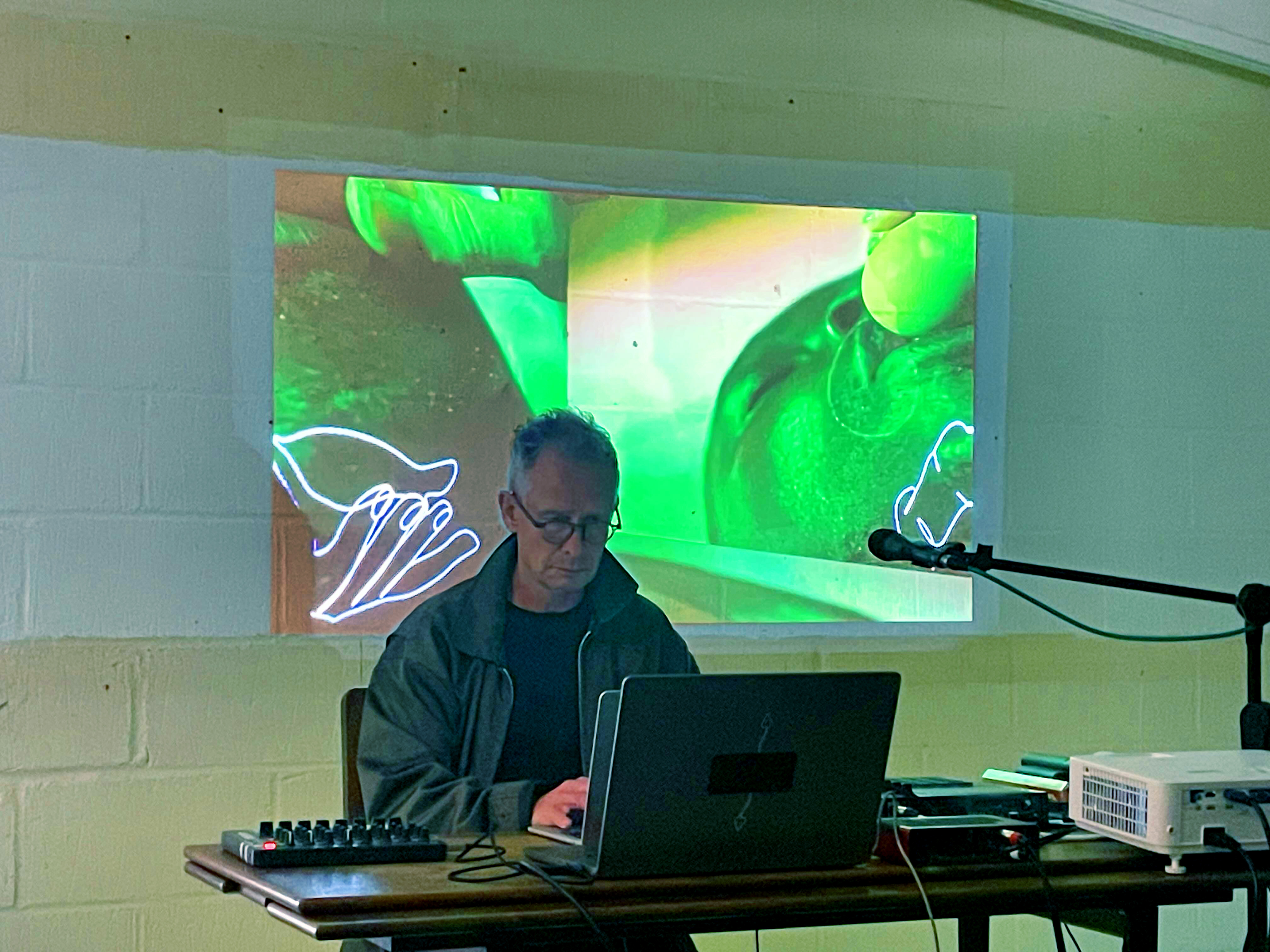
The event opened with performance by Per Hüttner, who also curated the evening’s content. In the performance he usesed moving images and sounds that have been created by the Swedish-Haitian collective Ghetto Gucci during a residency in the Caribbean in late 2024. The images show the collective when they investigate the overlaps between voodoo practices and contemporary performance. They are then imported into advanced 3D graphics that are modulated by Huttner in real time creating psychedelic-like landscapes. The sonic expression was also created in real time. In it, he mixed recordings by Ghetto Gucci with other samples and digital sounds. It moved between relaxing ambient, into noise, drone and wild drum sounds. Staying true to his style lent predominantly from dub traditions which also connected the sounds back to the West Indian background of the piece.